
✨ This article was AI edited. Editorial responsibility: BrooksideChurch.net.
Produced with AI. This article was artificially generated. Editorial responsibility: BrooksideChurch.net.
Lutheran Baptism: Sacramental Theology, Biblical Meaning, and Practice
Introduction to Lutheran Sacramental Theology
Lutheran baptismal theology stands as a cornerstone of the historic Christian faith, carefully articulating how God interacts with humanity. At the heart of this understanding is the belief that God uses physical, tangible means to deliver His spiritual promises. In Martin Luther’s profound theological framework, the sacraments are not empty signs or human works, but rather divine actions where God reaches down to sinful humanity to offer grace, forgiveness, and life.
When asking what makes Lutheran baptism distinct, one must first look to the Small and Large Catechisms of Martin Luther. In these foundational documents, Luther systematically dispels the notion that baptism is simply plain water. Instead, he defines it as “water comprehended in God’s command and connected with God’s Word.” This definition is crucial because it roots the power of the sacrament entirely in the Word and promise of God, rather than in the faith of the individual or the moral standing of the one administering it.
Holy Baptism as a Means of Grace (Gnadenmittel)
In Lutheran dogmatics, a “Means of Grace” (Gnadenmittel) refers to the specific, divinely instituted instruments through which the Holy Spirit creates and strengthens faith, and through which the forgiveness of sins is delivered to the individual. Baptism is one of these primary means, alongside the preaching of the Gospel (the Word) and the Lord’s Supper (the Eucharist).
For a Lutheran, baptism is not a work that man does for God. It is a work that God does for man. It is a Gospel-centered event. When the water is applied in the name of the Father, and of the Son, and of the Holy Spirit (Matthew 28:19), God is the primary actor. He is the one who washes, regenerates, and adopts the baptized individual into His eternal family. The water, combined with the Word, becomes a life-giving water, rich in grace, and a washing of the new birth in the Holy Spirit, as St. Paul writes in Titus 3:5-8.
The Doctrine of Baptismal Regeneration
One of the most defining characteristics of Lutheran theology is its staunch defense of baptismal regeneration. This is the biblical belief that the Holy Spirit actually brings about a new spiritual birth and creates faith through the sacrament of baptism. The Lutheran Confessions reject the idea that baptism is merely a symbol of a faith that already exists, or an outward sign of an inward grace that was received at a prior moment of conversion.
According to John 3:5, Jesus says, “Truly, truly, I say to you, unless one is born of water and the Spirit, he cannot enter the kingdom of God.” Lutherans take this text at face value, understanding that the Holy Spirit works through the waters of baptism to impart the new birth. Furthermore, in 1 Peter 3:21, the Apostle states unequivocally, “Baptism, which corresponds to this, now saves you, not as a removal of dirt from the body but as an appeal to God for a good conscience, through the resurrection of Jesus Christ.” For Lutherans, this salvation is an objective reality delivered in the sacrament.
The Connection of Faith, the Word, and Water
It is common for observers to ask, “How can water do such great things?” Luther addresses this directly in his Small Catechism, explaining that it is not the water that does these things, but the Word of God which is in and with the water, and faith, which trusts this Word of God in the water. Without the Word of God, the water is simply water and no baptism. But with the Word of God, it is a baptism, that is, a life-giving water.
Faith is essential in Lutheran theology, for faith is the receiving hand that grasps the promises offered in baptism. However, faith does not make the sacrament valid; the Word of God does. Even if a person were baptized without faith, the baptism itself remains a valid act of God. Yet, for the individual to receive the saving benefits of that baptism, faith is required. Thus, Lutherans baptize infants, trusting that the Holy Spirit can and does create faith in the hearts of the youngest children, just as He does in adults.
Drowning the Old Adam: A Life of Daily Repentance
In Lutheran practice, baptism is not viewed as a one-time event that is relegated to the past. Rather, it is a present reality that defines the entirety of the Christian life. Luther wrote profoundly about what baptism means for daily living. In the Small Catechism, he explains that baptism signifies that “the Old Adam in us should by daily contrition and repentance be drowned and die with all sins and evil desires, and that a new man should daily emerge and arise to live before God in righteousness and purity forever.”
This means that the Christian life is a continuous return to one’s baptism. When a Lutheran sins and repents, they are returning to the promises God made to them at the baptismal font. Daily repentance is the daily application of the grace received in baptism. It is a constant cycle of dying to sin (the Old Adam) and rising to new life in Christ. This daily rhythm provides immense comfort to the believer, whose assurance of salvation rests not on their own wavering emotions or moral performance, but on the objective, unchangeable promise of God spoken over them in the water.
Comparative Theology: Lutheran vs. Catholic, Calvinist, and Baptist Views
To fully understand the Lutheran position, it is helpful to contrast it with other major Christian traditions. While there are areas of agreement, the distinctions are profound and shape the entirety of one’s approach to the Christian life.
Roman Catholic View: Ex Opere Operato
While Lutherans share the belief in baptismal regeneration with Roman Catholics, they differ in the mechanics of how grace is imparted. The Catholic Church teaches that the sacraments work ex opere operato, meaning “by the very fact of the action’s being performed.” In this view, grace is infused into the soul automatically through the administration of the sacrament, provided the recipient places no obstacle in the way. Lutherans reject this mechanical view, insisting that while God’s promise is objective, the saving benefit is received only through faith, which trusts the Word attached to the water.
Calvinist (Reformed) View: Sign and Seal
The Reformed tradition, following John Calvin, views baptism primarily as a sign and seal of the Covenant of Grace. In this theology, baptism symbolizes the washing away of sins and seals the individual into the covenant community, but it does not in itself regenerate or save. For the Calvinist, regeneration is an immediate, internal work of the Holy Spirit that is often separated from the moment of baptism. Lutherans disagree, holding that the Holy Spirit has bound His regenerative work to the external means of the Word and sacrament.
Baptist View: An Ordinance of Obedience
The Baptist tradition diverges most sharply from the Lutheran understanding. For Baptists, baptism is an “ordinance,” a command to be obeyed, rather than a sacrament that delivers grace. It is seen as an outward symbol of an inward reality that has already occurred when the individual consciously placed their faith in Christ. Consequently, Baptists reject infant baptism, practicing only “believer’s baptism.” Lutherans counter this by arguing that baptism is God’s work, not man’s work, and therefore infants are perfect candidates for God’s grace, as they can contribute nothing to their salvation.
Structured Theological Comparison Table
| Theological Tradition | Nature of Baptism | Primary Actor | Purpose / Effect | Infant Baptism |
|---|---|---|---|---|
| Lutheranism | Means of Grace (Sacrament) | God | Forgiveness of sins, regeneration, imparts the Holy Spirit | Practiced (God creates faith in infants) |
| Roman Catholicism | Sacrament (ex opere operato) | God (through the Church) | Infuses grace, washes away original sin, regeneration | Practiced |
| Calvinism (Reformed) | Sign and Seal of the Covenant | God (signifying) / Believer (receiving) | Marks entry into the covenant community, symbolizes grace | Practiced (as a covenantal sign) |
| Baptist | Ordinance / Symbolic Act | The Believer | Public profession of faith, obedience to Christ’s command | Rejected (Believer’s baptism only) |
The Role of the Sponsor (Godparent) in Lutheran Practice
In Lutheran congregations, the practice of having sponsors, commonly known as godparents, is deeply rooted in history and pastoral care. Sponsors serve as witnesses to the baptism, ensuring that the sacrament was administered correctly according to Christ’s institution. More importantly, they make a solemn pledge to pray for the baptized child, to remind them of their baptism, and to assist in their Christian upbringing, especially if the parents should fail in their duty or pass away.
The role of the sponsor is not merely a social honor; it is a spiritual responsibility. Sponsors are expected to be faithful, communicating members of the church who can model a life of daily repentance and faith in Christ. They are partners in the ongoing catechesis of the child, helping to ensure that the seed of faith planted in baptism is nurtured through regular attendance at the Divine Service and instruction in the Scriptures and the Catechism.
Emergency Baptism in the Lutheran Tradition
Because Lutherans believe that baptism is the ordinary means by which God delivers salvation, they take the necessity of the sacrament very seriously. This is most evident in the practice of emergency baptism. If an infant is born in severe medical distress and is not expected to live, or if a person is in imminent danger of death, any Christian is authorized and encouraged to administer a valid baptism.
An emergency baptism is remarkably simple. The Christian takes water, applies it to the person (usually by pouring it on the head), and says, “I baptize you in the name of the Father, and of the Son, and of the Holy Spirit. Amen.” Following an emergency baptism, if the person survives, the baptism is not repeated. Instead, the baptism is publicly recognized and ratified in a church service, affirming the validity of the sacrament administered in the moment of crisis.
Conclusion: The Enduring Comfort of the Font
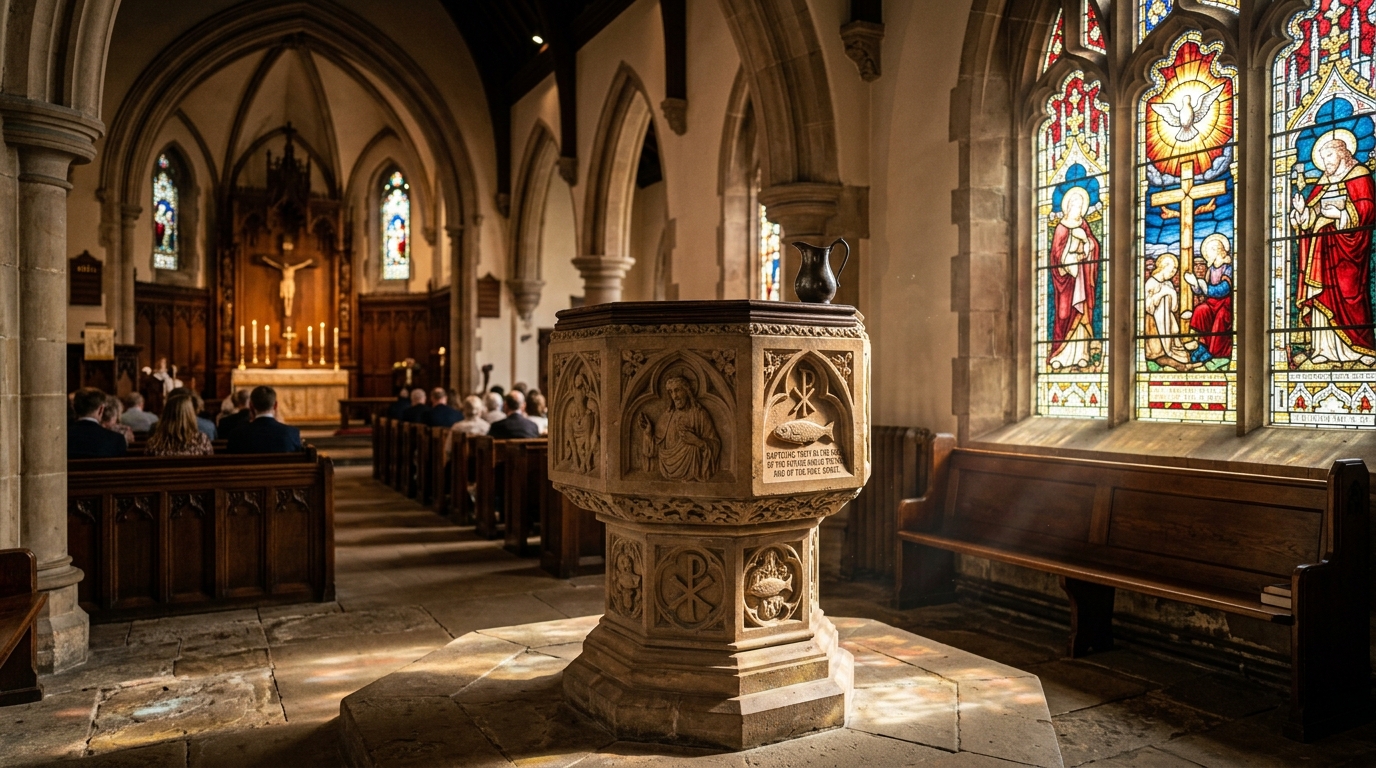
For the Lutheran Christian, the baptismal font is a source of unending comfort and absolute assurance. In a world characterized by uncertainty, moral failure, and spiritual doubt, the objective reality of baptism stands firm. It is the rock upon which faith can securely rest, because it is the work of a faithful God who cannot lie and who never breaks His promises.
When the devil accuses, when conscience terrifies, and when the Law condemns, the Lutheran is taught to respond with three simple words: Baptizatus sum—”I am baptized.” This is not a boast in one’s own righteousness, but a boast in the righteousness of Christ, freely given in the waters of Holy Baptism. Through this Means of Grace, God has claimed us, washed us, and sealed us for eternity, calling us to a life of daily repentance and joyous faith in our Savior.
Frequently Asked Questions
Does Lutheranism teach that baptism saves you?
Yes, Lutheranism teaches that baptism saves, based directly on scriptures like 1 Peter 3:21 (“Baptism… now saves you”) and Titus 3:5. However, it is not the water itself that saves, but the Word of God connected with the water, which delivers the forgiveness of sins and creates the faith that receives this salvation.
Why do Lutherans baptize infants?
Lutherans baptize infants because baptism is God’s work, not man’s. Infants are born sinful and need God’s grace, and God commands all nations to be baptized. Furthermore, Lutherans believe that the Holy Spirit is fully capable of creating faith in the hearts of infants through the Word connected to the water.
Can a person be saved without baptism?
While Lutherans emphasize that baptism is the ordinary means by which God delivers salvation, they also recognize that it is not the absolute deprivation of baptism that condemns, but the despising of it. God is not bound by His sacraments, though we are. The thief on the cross is a prime example of one saved without baptism.
Do Lutherans rebaptize people?
No, Lutherans do not practice rebaptism. If a person was baptized in the name of the Triune God (Father, Son, and Holy Spirit) with water, even in another Christian denomination, that baptism is considered valid. Because baptism is God’s work, it does not need to be repeated, even if the person fell away from faith and later returned.
Get our latest guides, news, and insights highlighted in your Google Search & AI Overviews.