
✨ This article was AI edited. Editorial responsibility: BrooksideChurch.net.
Produced with AI. This article was artificially generated. Editorial responsibility: BrooksideChurch.net.
Ancient Westmeath Baptismal Fonts: Irish Medieval Stonework & Sacramental Heritage
Westmeath baptismal fonts are medieval stone basins, primarily octagonal and carved from local limestone during the 15th century, used for Christian sacraments in County Westmeath, Ireland. Notable examples at Multyfarnham, Fore Abbey, and Kilbixy feature intricate Romanesque and Gothic relief carvings depicting the Apostles, the Crucifixion, and indigenous Celtic iconography, representing critical artifacts of Irish liturgical heritage.
The Liturgical and Architectural Context of Gaelic Christian Fonts
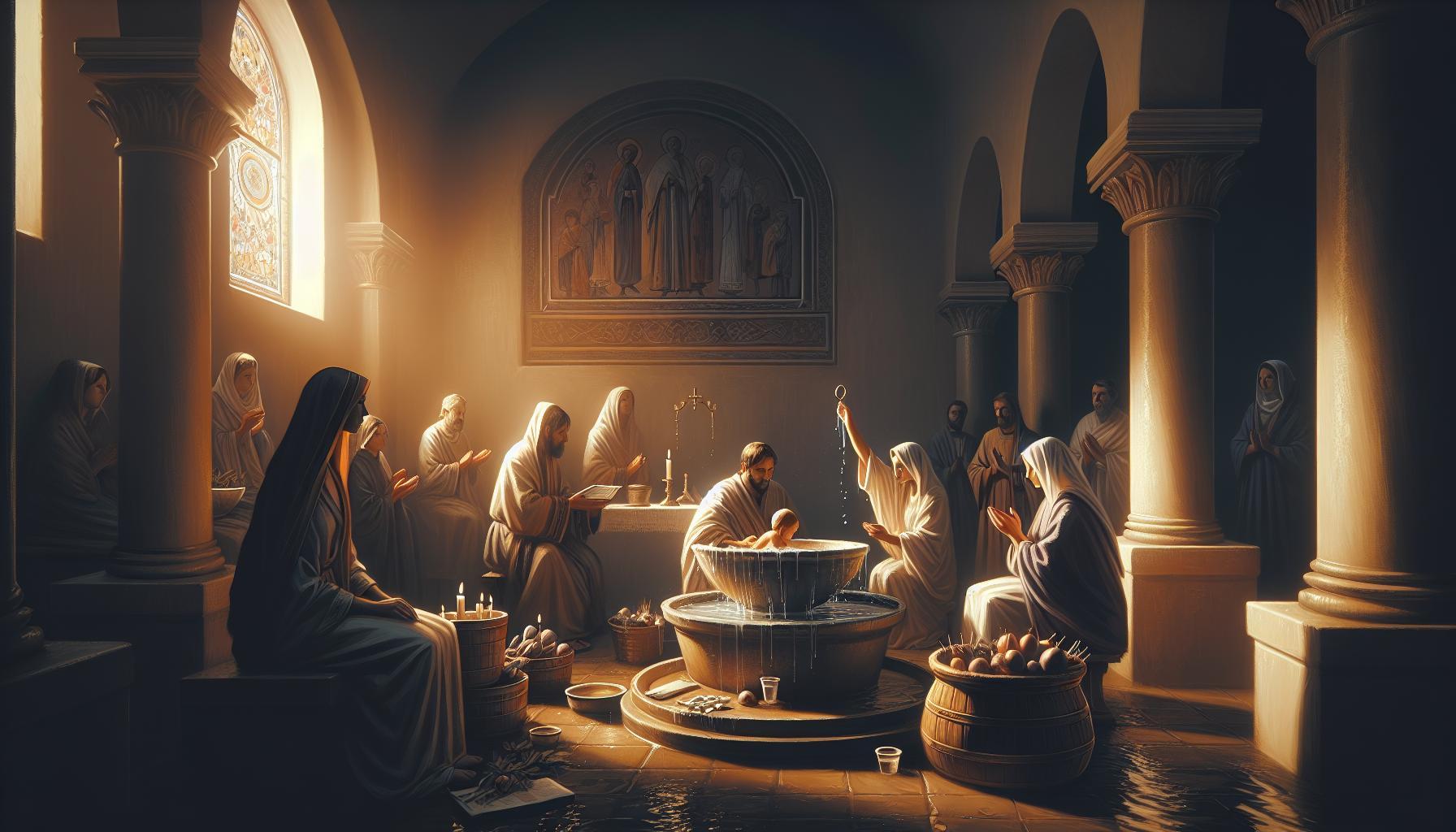
The transition from early monastic settlements to the parish system in Ireland brought about significant changes in church architecture and liturgical furnishings. Among the most enduring artifacts of this era are the stone baptismal fonts found scattered across County Westmeath. These fonts were not merely functional vessels for the sacrament of baptism; they were deeply symbolic centerpieces of the medieval parish church, representing the entry point into the Christian community and the profound theological mysteries of rebirth and purification.
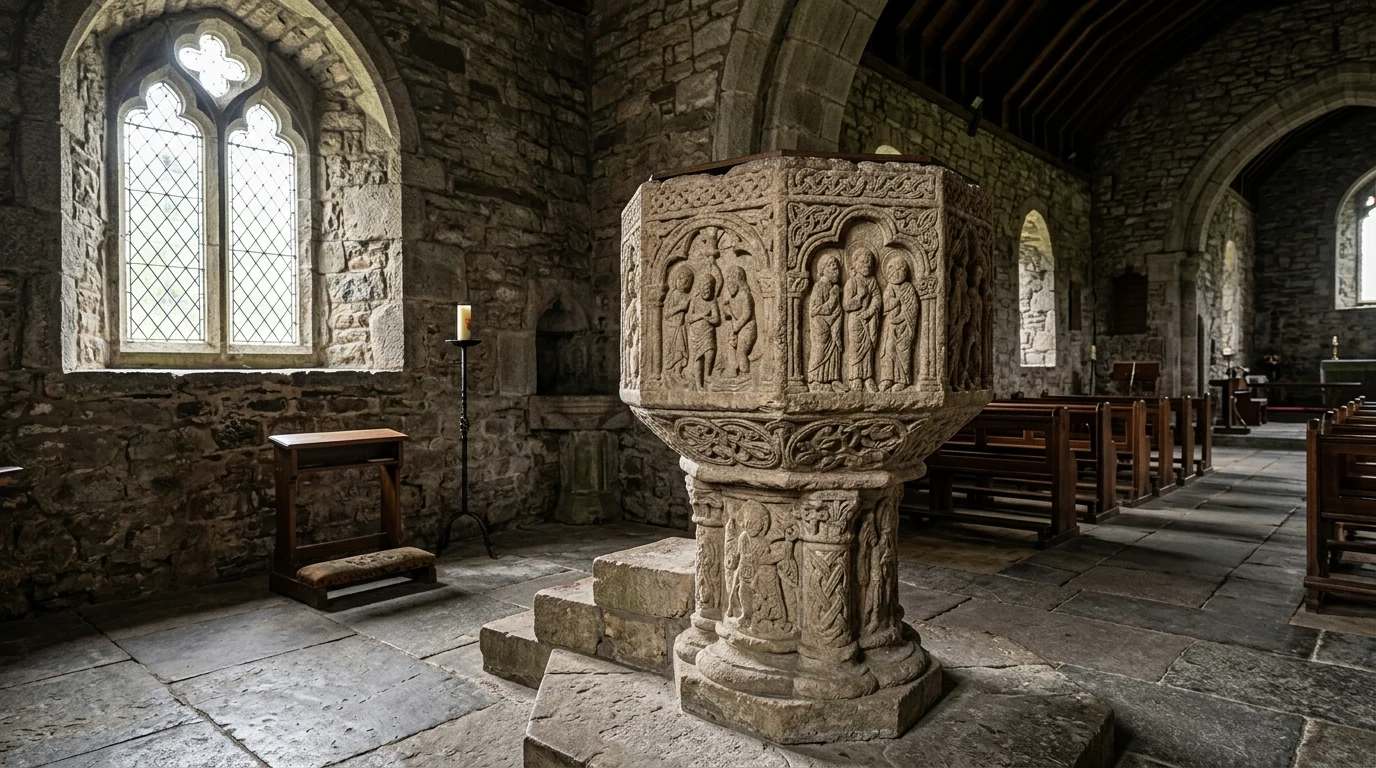
Constructed primarily from local limestone, these fonts demonstrate the exceptional skill of medieval Irish stonemasons. The evolution of font design in Westmeath mirrors broader architectural trends across Europe, transitioning from the simple, unadorned tub-shaped fonts of the Romanesque period to the highly elaborate, octagonal masterpieces of the Gothic era. The octagonal shape itself is highly symbolic, representing the “eighth day” of creation—the day of Christ’s resurrection and the new creation inaugurated by baptism.
These stone basins were typically positioned near the entrance of the church, specifically the south door, emphasizing their role as the threshold of faith. The sheer weight and permanence of these objects reflect the central importance of the baptismal rite in medieval society, serving as a constant visual reminder of the sacramental foundation of the Christian life.
The intricate relief carvings found on the later Gothic fonts of Westmeath provide a fascinating window into medieval piety and theology. Depictions of the Apostles, the Crucifixion, angels, and various saints served an essential pedagogical function, acting as “books for the unlearned” (biblia pauperum) and visually communicating the core tenets of the faith to a largely illiterate congregation. Furthermore, the synthesis of these universal Christian motifs with indigenous Celtic patterns and iconography demonstrates the unique cultural context of medieval Irish Christianity, where broader European influences were continually adapted and localized.
The survival of these fonts is a testament to their enduring significance. While many medieval churches in Westmeath fell into ruin or were extensively modified over the centuries, the baptismal fonts often remained, recognized as sacred objects worthy of preservation. Today, they stand as vital archaeological and historical monuments, offering invaluable insights into the religious practices, artistic achievements, and cultural identity of medieval Ireland.
In particular, the geological footprint of these fonts is striking. Quarries across the Midlands provided the raw material, usually a fine-grained, dark grey limestone that allowed for crisp, detailed carving. The extraction and transportation of these massive blocks of stone would have represented a significant logistical undertaking, further underscoring the importance placed upon the creation of these sacred objects by medieval communities.
Detailed Examination of Key Westmeath Fonts
Multyfarnham Franciscan Friary
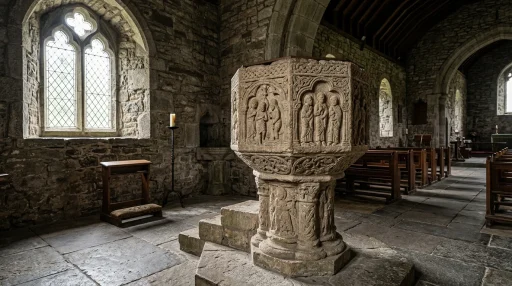
The baptismal font at Multyfarnham is perhaps one of the most celebrated examples in Westmeath. Associated with the historic Franciscan friary, this font exhibits remarkable craftsmanship and theological depth. The octagonal basin is adorned with high-relief carvings, most notably featuring representations of the Apostles. The precision of the stonework, despite centuries of weathering, highlights the advanced skills of the masons operating in this region during the late medieval period. The Multyfarnham font serves as a profound example of how Franciscan spirituality, with its emphasis on the humanity of Christ and the apostolic mission, influenced local artistic production.
The preservation of the Multyfarnham font is closely tied to the enduring presence of the Franciscan community in the area, who managed to maintain a continuous, albeit sometimes clandestine, presence despite the suppressions of the Reformation and subsequent penal eras. The font stands not only as an artistic treasure but as a symbol of religious resilience and continuity.
Further analysis of the Multyfarnham carvings reveals a sophisticated understanding of contemporary theological debates, subtly encoded in the posture and attributes of the depicted figures. The interplay of light and shadow across the deeply incised limestone further enhances the dramatic impact of the narrative scenes, suggesting that the font was designed to be viewed in the dynamic, flickering light of candles and torches within the medieval church interior.
Fore Abbey
Fore Abbey, famously associated with St. Feichin and the “Seven Wonders of Fore,” possesses a baptismal font that reflects the immense historical and spiritual significance of the site. While perhaps less ornately decorated than the Multyfarnham example, the Fore Abbey font commands attention through its sheer scale and robust, almost archaic simplicity. The font’s design echoes the ancient monastic origins of the site, serving as a tangible link between the early Christian period and the later, more formalized parish structures of the medieval era.
The context of the Fore Abbey font within a major pilgrimage center suggests that it played a role in the spiritual experiences of countless visitors over the centuries. The font, like the other “wonders” of Fore, became imbued with a sense of the miraculous and the sacred, reinforcing the site’s status as a premier destination for spiritual renewal and physical healing.
The geological composition of the Fore font, sourced from local quarries, underscores the deep connection between the spiritual life of the community and the physical landscape of Westmeath. The enduring nature of the stone itself serves as a metaphor for the permanence of the faith and the enduring legacy of St. Feichin’s monastic foundation.
Kilbixy
The font at Kilbixy is a prime example of the transition between the Romanesque and Gothic styles. Situated in a parish with deep historical roots, the Kilbixy font features distinctive decorative elements that distinguish it from its contemporaries. The carvings here often exhibit a more stylized, almost abstract quality, reflecting perhaps a localized artistic tradition or the influence of specific traveling masons. The Kilbixy font is particularly notable for its integration of geometric patterns with more representational motifs, creating a complex visual language that requires careful deciphering.
The history of Kilbixy, once a significant medieval borough that later declined in importance, adds a layer of poignancy to the survival of its baptismal font. The font remains one of the few tangible remnants of the settlement’s former prosperity and spiritual vitality, serving as a silent witness to the changing fortunes of the region.
Scholarly debate continues regarding the specific iconographic program of the Kilbixy font, with some suggesting connections to obscure local legends or specific theological tracts popular in the region during its construction. Regardless of the precise interpretation, the font’s artistic merit and historical value are undeniable, making it a crucial piece of the puzzle in understanding the medieval heritage of Westmeath.
Clonfad and Delvin
The fonts at Clonfad and Delvin, while perhaps less widely known than those at Multyfarnham or Fore, are equally significant for their contribution to our understanding of regional variations in font design. The Clonfad font, with its distinctive bowl shape and subtle ornamentation, points to an earlier, perhaps more austere, liturgical tradition. In contrast, the Delvin font exhibits characteristics of the later, more elaborate Gothic style, demonstrating the gradual spread of these artistic innovations across the county.
The study of these less prominent fonts is essential for developing a comprehensive typology of Westmeath baptismal fonts. By comparing the subtle differences in form, material, and decoration, researchers can begin to trace the movement of specific workshops or individual masons, shedding light on the complex networks of artistic exchange that characterized medieval Ireland.
Furthermore, the preservation and documentation of fonts in smaller, rural parishes like Clonfad and Delvin highlight the vital role that local communities play in safeguarding their heritage. These objects, often overlooked by grander historical narratives, provide an intimate and immediate connection to the lived religious experiences of ordinary people in the medieval period.
The craftsmanship in Delvin, in particular, showcases a fascinating blend of localized stonework techniques combined with continental influences. The octagonal form is sharply defined, suggesting the use of advanced masonry tools and a clear understanding of geometric principles by the craftsmen involved.
Theological Symbolism in Stone
The design and decoration of medieval baptismal fonts were deeply embedded in the theological understanding of the sacrament. The octagonal shape, as previously mentioned, was not merely an aesthetic choice but a profound theological statement, referencing the eighth day of creation and the inauguration of a new, redeemed world through the waters of baptism. The font was conceptually understood as a tomb—where the old, sinful self was buried with Christ—and a womb, from which the new Christian was born into the life of the Church.
The carvings that adorned these fonts further amplified this theological message. Depictions of the Crucifixion served as a stark reminder of the cost of redemption and the source of the sacrament’s power. Images of the Apostles emphasized the apostolic succession and the integration of the newly baptized into the universal Church. The inclusion of saints, particularly local patrons, reinforced the communal aspect of the faith and the belief in the intercession of the heavenly host.
The interplay of water, stone, and light within the medieval church created a powerful sensory experience that underscored the solemnity and transformative nature of the baptismal rite. The font, as the focal point of this experience, was designed to inspire awe and reverence, visually communicating the profound mysteries of the faith to all who approached it.
It is also important to note the concept of “living water” in Celtic Christianity, which likely influenced the perception of these stone basins. The fonts were not just containers; they were seen as sacred wellsprings, connecting the earthly ritual of baptism with the divine source of life and grace. The carvings often emphasize this connection through the use of foliate motifs and interlacing patterns that evoke the natural world and the endless flow of creation.
Moreover, the physical placement of the font within the ecclesiastical space carried significant meaning. As mentioned, its proximity to the entrance underscored its role as the gateway to the sacraments. The journey from the font to the altar mirrored the spiritual journey of the Christian life, moving from initiation to full communion.
Conservation and Archaeological Significance
The preservation of Westmeath’s medieval baptismal fonts presents an ongoing challenge for conservationists and heritage professionals. Centuries of exposure to the elements, as well as fluctuating environmental conditions within historic church buildings, have taken their toll on the delicate limestone carvings. Issues such as structural instability, surface erosion, and biological growth require careful monitoring and expert intervention.
Modern conservation techniques prioritize the stabilization of the stone and the prevention of further deterioration, often employing non-invasive methods such as laser cleaning and the application of breathable consolidants. The goal is not to restore the fonts to a pristine, “as-new” condition, but rather to preserve their historical integrity and the patina of age that forms an essential part of their character.
From an archaeological perspective, these fonts are invaluable primary sources. They provide concrete evidence of medieval artistic techniques, trade networks, and liturgical practices. The careful documentation and analysis of these objects, including 3D scanning and photogrammetry, are essential for advancing our understanding of medieval Irish society and ensuring that this vital aspect of our cultural heritage is preserved for future generations.
The ongoing study of Westmeath’s baptismal fonts continues to yield new insights and discoveries. As researchers uncover previously unrecognized details or make new connections between different fonts, our understanding of the rich and complex tapestry of medieval Irish Christianity is continually refined and expanded.
These ancient stone basins, once the center of communal spiritual life, remain potent symbols of endurance and continuity, inviting us to reflect on the deep historical roots of our faith and the enduring legacy of the craftsmen who shaped them. The meticulous work of preserving these artifacts ensures that future generations can appreciate not only their aesthetic value but also the profound spiritual narratives they embody.
Comparison Matrix of Key Historical Fonts in Westmeath
| Location | Era/Style | Shape | Key Iconography | Condition |
|---|---|---|---|---|
| Multyfarnham | 15th C. Gothic | Octagonal | Apostles, high-relief figures | Excellent, housed within friary |
| Fore Abbey | Romanesque transition | Square/Robust | Minimalist, geometric | Weathered, robust structural integrity |
| Kilbixy | Transitional Gothic | Octagonal | Stylized geometric & representational | Fair, some surface erosion |
| Clonfad | Early Medieval/Romanesque | Bowl/Tub | Austere, minimal ornamentation | Good, simple preservation |
| Delvin | Late Gothic | Octagonal | Foliate and Apostle motifs | Good, localized wear |
The study of these ecclesiastical artifacts is a continuous journey. As new technologies like LiDAR and high-resolution photogrammetry are applied to the study of these fonts, we uncover finer details of the masons’ tool marks and subtle iconographic elements that have been obscured by centuries of weathering. The fonts of Westmeath are not static relics but dynamic texts in stone, waiting to be read and interpreted by each successive generation.
Local historical societies and conservation groups play a crucial role in safeguarding these treasures. Through community engagement and education, awareness of the significance of these baptismal fonts is maintained, ensuring that they remain protected and valued components of the local landscape.
Furthermore, the academic study of these objects contributes to broader discussions regarding the cultural and artistic integration of Ireland within the wider European context during the Middle Ages. The Westmeath fonts demonstrate that Irish craftsmen were fully participating in contemporary artistic movements, adapting and interpreting them through the lens of their own unique cultural traditions.
Ultimately, the ancient stone baptismal fonts of Westmeath serve as a powerful testament to the enduring nature of human creativity and the human desire to give physical form to the transcendent. They stand as enduring monuments to the faith, skill, and artistry of the medieval period, offering a profound connection to our shared past.
For visitors and scholars alike, the journey through Westmeath’s ecclesiastical landscape is a journey through time. Each font tells a story of faith, craftsmanship, and community resilience that continues to resonate today. By carefully preserving and studying these remarkable objects, we ensure that their stories will continue to be told for centuries to come, enriching our understanding of Ireland’s profound spiritual and artistic heritage.
Get our latest guides, news, and insights highlighted in your Google Search & AI Overviews.